
Persian Engineering & Architecture: 3,000 Years of Innovation
Persian Engineering & Architecture: 3,000 Years of Innovation
Last updated: Feb 1, 2026Persian Engineering & Architecture: 3,000 Years of Innovation
When we speak of Persian engineering, we are not discussing mere construction. We are examining a civilization that approached infrastructure as living systems—networks designed to survive millennia, adapt to changing conditions, and maintain coherence across catastrophic disruptions.
From the subterranean Qanat networks that brought water to impossible deserts, to the acoustic precision of turquoise domes that canceled echo, Persian engineering represents a fundamental understanding: durability comes from resonance with nature, not conquest of it.
The Qanat: History’s First Decentralized Grid
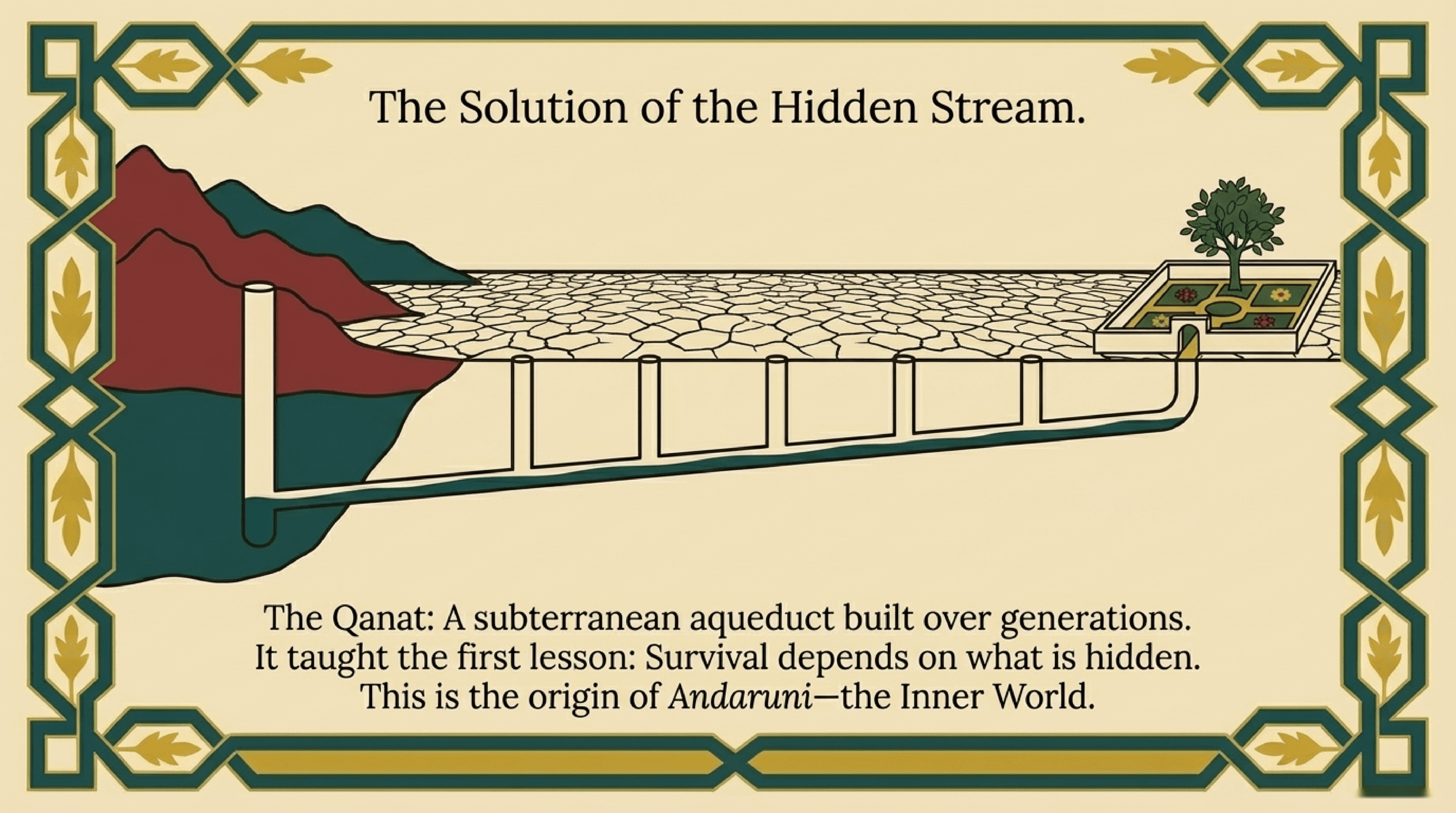
The Qanat is perhaps the most profound engineering achievement in human history—not for its scale, but for its architecture of resilience.
System Architecture
Unlike Roman aqueducts that dominated the landscape as visible monuments to imperial power, the Qanat operates as an invisible network:
- Underground Distribution: Water flows through subterranean channels, protected from evaporation and enemy sabotage
- Modular Nodes: Vertical shafts act as access points—if one fails, the system continues
- Community Ownership: Built and maintained by local networks, not centralized authority
- Gravity-Powered: No external energy required; the system runs on pure physics
The Liquid Fortress Principle
The Qanat embodies the core logic of the Liquid Fortress: true infrastructure cannot be seen from the sky. When invaders conquered Persian cities, they destroyed palaces and walls. But the Qanat continued flowing, sustaining life in the Andaruni (the hidden world).
This is Level 1 (μ1) engineering at its finest—building systems that outlive empires.
Modern Applications
Today’s decentralized networks (blockchain, mesh networks, peer-to-peer systems) are rediscovering Qanat logic: distribute the nodes, hide the infrastructure, ensure no single point of failure.
Stone vs. Concrete: The Entropy of Modernity
The modern concrete revolution introduced a fundamental problem: materials with expiration dates.
The Problem with Concrete
Modern reinforced concrete has a lifespan of 50-100 years. Why?
- Internal Decay: Steel rebar rusts, expanding and cracking the concrete from within
- Chemical Instability: Portland cement reacts with environmental conditions
- Thermal Stress: Temperature variations create micro-fractures
- Designed Obsolescence: Built for rapid construction, not long-term survival
The Wisdom of Ancient Materials
In contrast, structures built 2,500 years ago still stand:
Persepolis (515 BCE):
- Massive stone blocks fitted without mortar
- Material resonance with local geology
- Structural honesty—compression-based design
Taq Kasra (540 CE):
- World’s largest unreinforced brick arch
- Geometry carries the load, not internal tension
- 1,500 years of continuous uptime
Engineering Philosophy
The difference is philosophical:
Modern Approach: Dominate materials through internal reinforcement Persian Approach: Work with material properties, use geometry to distribute forces
The lesson is clear: True durability comes from understanding natural resonance, not forcing artificial structures.
The Muqarnas: Computational Geometry Before Computers

The Muqarnas vault is one of the most sophisticated architectural innovations in history—a fractal solution to a geometric problem.
The Structural Challenge
How do you transition from a square base (Earth, materiality) to a circular dome (Sky, infinity)?
Western architecture used pendentives—simple curved triangles. Persian engineers developed recursive honeycomb cells that fractalize the transition.
Computational Properties
- Visual Fractalization: Each cell subdivides the mass, creating infinite detail
- Light Distribution: Thousands of surfaces catch and scatter photons
- Acoustic Precision: Sound waves are absorbed and redirected
- Structural Efficiency: Load is distributed across countless micro-arches
The Algorithm
The Muqarnas is literally a geometric algorithm executed in brick and plaster. Long before computer graphics, Persian architects were running recursive functions to generate complex three-dimensional forms.
This is μ5 (Garden) level engineering—where mathematics becomes art, and structure becomes symbol.
The Persian Garden: Engineered Paradise

The Persian Garden (Bagh) is not decoration—it’s a precision-engineered environment for human coherence.
The Four-Quadrant System (Chahar Bagh)
The layout follows strict mathematical principles:
- Axial Symmetry: Water channels divide space into four sections (representing the four elements, four seasons, four rivers of paradise)
- Hydraulic Engineering: Carefully calculated gradients maintain water flow without pumps
- Microclimate Control: Strategic placement of trees and water features creates cooling
- Acoustic Design: Flowing water masks urban noise
Engineering the Senses
Every element serves a function:
- Visual: Geometric patterns create coherence
- Auditory: Water sounds induce relaxation
- Olfactory: Jasmine and rose release specific compounds
- Tactile: Temperature gradients guide movement
This is environmental engineering centuries before HVAC systems—using natural physics to create optimal human conditions.
The Dome: Acoustic and Structural Mastery
The Persian double-shell dome is a masterpiece of multi-domain engineering.
Structural Innovation
- Double Shell: Inner and outer domes separate visual and structural requirements
- Load Distribution: Pointed profile shifts lateral thrust downward
- Material Efficiency: Achieves massive spans with minimal material
- Seismic Resistance: Flexibility allows movement during earthquakes
Acoustic Engineering
The most remarkable feature is intentional silence:
- Curved surfaces focus sound to specific points
- Material absorption prevents echo
- Geometry creates “quiet zones” for contemplation
This is engineering as noise cancellation—creating physical spaces that support mental coherence.
Timeline of Innovation
Ancient Period (550 BCE - 650 CE)
550 BCE: First documented Qanat systems 515 BCE: Persepolis construction begins—stone engineering at peak 224 CE: Sasanian architecture introduces the squinch (proto-Muqarnas) 540 CE: Taq Kasra—largest brick vault ever built
Islamic Golden Age (650 - 1500 CE)
1088 CE: Isfahan Friday Mosque—first true Muqarnas vaults 1598 CE: Isfahan becomes capital—urban planning on unprecedented scale 1602 CE: Sheikh Lotfollah Mosque—acoustic perfection achieved 1629 CE: Fin Garden—hydraulic engineering masterpiece
Modern Era (1800 - Present)
1850: Qanat systems still provide 75% of Iran’s water 1970: Ancient engineering principles studied by modern architects 2016: Persian Qanat recognized by UNESCO as World Heritage 2025: Decentralized systems rediscover Qanat logic
Core Principles of Persian Engineering
Through three millennia of innovation, certain axioms emerge:
1. Invisibility is Strength
The most durable infrastructure is hidden from attack. Build underground, build distributed, build to survive conquest.
2. Geometry Carries Load
Use mathematical principles to distribute forces. Rely on compression, not tension. Let physics do the work.
3. Material Resonance
Work with local materials and environmental conditions. Don’t fight nature—synchronize with it.
4. Fractal Efficiency
Solve problems through recursive subdivision. Break complexity into repeating simple patterns.
5. Multi-Domain Integration
True engineering serves multiple purposes simultaneously: structural + acoustic + thermal + aesthetic + symbolic.
6. Long-Term Signal Stability
Build for millennia, not decades. Measure success by how long the system maintains coherence, not how quickly it can be constructed.
Modern Relevance: Engineering for Collapse Resistance
In an age of systemic fragility, Persian engineering offers a roadmap:
For Infrastructure: Build decentralized, modular systems that can survive partial failures For Architecture: Use passive systems (gravity, thermal mass, natural ventilation) instead of active dependence on external energy For Urban Planning: Create networks, not hierarchies—distributed resilience instead of centralized vulnerability For Technology: Learn from systems that ran for 2,500 years without software updates
The Living Tradition
Persian engineering is not a museum artifact. These principles are actively solving modern problems:
- Passive cooling: Using thousand-year-old windcatcher (badgir) designs to cool buildings without electricity
- Water management: Qanat restoration projects providing drought-resilient water supplies
- Seismic design: Traditional earthquake-resistant construction outperforming modern buildings
- Acoustic engineering: Dome geometry informing concert hall and recording studio design
Conclusion: Infrastructure as Civilizational OS
When we study Qanats, ancient materials, computational geometry, engineered gardens, and silent domes, we’re not learning history—we’re learning systems design from the longest-running civilizational operating system on Earth.
Persian engineering teaches a fundamental truth: The most advanced technology is the one that runs longest with the least external input.
In the μ-Stack framework, this is Level 1 (Roots) mastery—building physical infrastructure so robust, so in harmony with natural law, that it outlives the empires that created it.
Explore Further
Engineering Systems
Architectural Innovation
- Muqarnas: The Geometry of the Void
- The Geometry of Silence: Why Persian Domes Don’t Echo
- The Persian Garden
Related Art & Artifacts
Philosophy & Systems
Axiom: The most durable civilization is the one that builds infrastructure resonant with natural law, invisible to conquerors, and distributed across the swarm.