
The Complete Guide to Persian Cultural Architecture: Engineering, Geometry, and 3,000 Years of Innovation
The Complete Guide to Persian Cultural Architecture: Engineering, Geometry, and 3,000 Years of Innovation
Last updated: Feb 1, 2026The Complete Guide to Persian Cultural Architecture: Engineering, Geometry, and 3,000 Years of Innovation
When we examine Persian architecture, we are not studying monuments to imperial power. We are analyzing the longest-running civilizational operating system in human history—a 3,000-year research program that discovered how to build infrastructure that survives empires, adapts to climate extremes, and maintains coherence across catastrophic disruptions.
From underground qanat networks that operated as decentralized grids before the internet, to fractal muqarnas vaults that solved computational geometry without computers, Persian engineering represents a fundamental philosophical shift: durability comes from resonance with natural law, not conquest of nature.
This comprehensive guide explores the core innovations, principles, and modern applications of Persian architectural genius.
Table of Contents
- The Philosophical Foundation: Liquid vs. Stone
- The Qanat: History’s First Decentralized Grid
- Materials Science: Stone vs. Concrete
- The Muqarnas: Computational Geometry Before Computers
- The Persian Dome: Acoustic and Structural Mastery
- The Persian Garden: Engineering Paradise
- Timeline: 3,000 Years of Innovation
- Core Architectural Principles
- Modern Applications: Lessons for the 21st Century
- Case Studies: Structures That Defied Time
- Further Reading & Related Topics
The Philosophical Foundation: Liquid vs. Stone
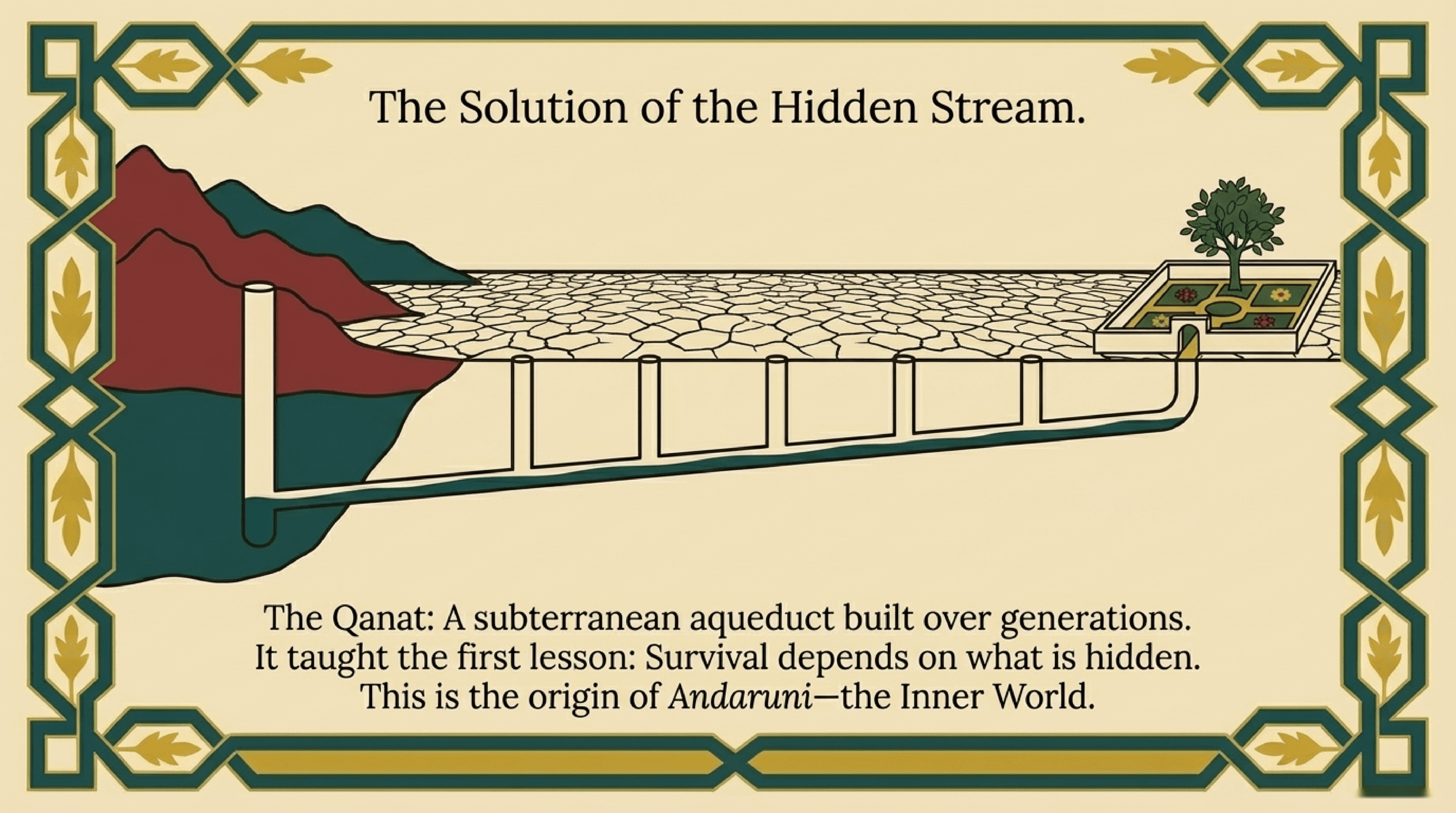
Persian architecture emerged from a radical philosophical insight encoded in the Liquid Fortress concept: True infrastructure cannot be seen from the sky.
The Stone Fortress Paradigm
Western architectural tradition builds Stone Fortresses:
- Massive walls proclaiming power
- Centralized monuments to authority
- Visible, imposing, immovable structures
- Designed to intimidate and dominate
When conquered, these fortresses fall. The symbol of power becomes the symbol of defeat.
The Liquid Fortress Alternative
Persian architecture builds Liquid Fortresses:
- Invisible infrastructure: Underground systems protected from sabotage
- Distributed networks: Modular nodes that survive partial destruction
- Adaptive geometry: Structures that flex rather than break
- Community ownership: Maintained by local knowledge, not central bureaucracy
The Andaruni (the hidden world) preserves what the Biruni (the visible world) cannot protect.
The μ-Stack Framework
This duality maps to the μ-Stack—the seven-layer hierarchy of civilization:
μ1 (Roots): Physical infrastructure—qanats, foundations, materials μ2 (Rhythm): Daily patterns—how spaces shape human behavior μ3 (Fire): Emotional resonance—spaces that inspire courage and contemplation μ4 (Map): Geometric logic—mathematical precision in design μ5 (Garden): Symbolic beauty—fractal patterns connecting earth to sky μ6 (Story): Narrative architecture—buildings that tell civilizational epics μ7 (Sky): Metaphysical orientation—structures pointing toward the absolute
True Persian architecture operates on all seven layers simultaneously.
The Qanat: History’s First Decentralized Grid
The qanat is arguably the most profound engineering achievement in human history—not for its scale, but for its architecture of resilience.
System Architecture
Unlike Roman aqueducts that dominated landscapes as visible monuments to imperial power, the qanat operates as an invisible network:
1. Underground Distribution
- Water flows through subterranean channels
- Protected from evaporation in extreme desert climates
- Invisible to enemy reconnaissance and sabotage
- Temperature-regulated natural cooling
2. Modular Node Design
- Vertical access shafts spaced every 20-200 meters
- Each shaft acts as an independent maintenance point
- If one node fails, the system continues operating
- Repairs can be made without shutting down the network
3. Community Ownership Model
- Built and maintained by local communities (Muqannis)
- Knowledge passed through master-apprentice chains
- No centralized authority required for operation
- Economic incentives aligned with long-term maintenance
4. Pure Physics Operation
- Gravity-powered water transport—no external energy needed
- Taps mountain aquifers at the source
- Gentle slope (1:1000) maintains flow without erosion
- System runs continuously for centuries without “updates”
The Liquid Fortress Principle in Action
The qanat embodies the core logic of the Liquid Fortress: true infrastructure operates below the surface.
Historical Evidence:
- When invaders conquered Persian cities, they destroyed palaces, walls, temples
- But the qanat continued flowing, sustaining life in the hidden world
- Empires fell, but the water system persisted
- Some qanats have operated continuously for over 2,500 years
This is Level 1 (μ1) engineering at its finest—building systems that outlive empires.
Technical Specifications
Construction Method:
- Identify underground water source via test wells
- Dig “mother well” at aquifer base (up to 300 meters deep)
- Calculate slope for gravity flow (typically 1:1000 gradient)
- Dig tunnel toward settlement, removing spoil via vertical shafts
- Space shafts based on depth and soil stability
- Line tunnel with stone or brick where needed
Performance Metrics:
- Lifespan: 500-2,500+ years with maintenance
- Efficiency: Minimal water loss compared to surface channels
- Range: Some qanats transport water over 70 kilometers
- Output: Individual qanats provide 2-200 liters per second
Modern Applications
Today’s decentralized technologies rediscover qanat logic:
Blockchain: Distributed ledger with modular nodes Mesh Networks: Decentralized communication without central servers Peer-to-Peer Systems: Direct connections without hierarchical routing Microgrids: Local energy distribution resilient to grid failures
The principle remains: Distribute the nodes, hide the infrastructure, ensure no single point of failure.
The Qanat in Numbers
- 3,000 years: Age of oldest known qanats
- 37,000: Number of qanats in Iran (circa 1960)
- 75%: Percentage of Iran’s water supplied by qanats (1850)
- 2016: UNESCO World Heritage recognition for Persian Qanat systems
- Present: Qanats still operational in Iran, Afghanistan, Oman, Yemen, North Africa
Materials Science: Stone vs. Concrete
The modern concrete revolution introduced a critical problem: materials with expiration dates.
The Problem with Modern Reinforced Concrete
Modern structures have a designed lifespan of 50-100 years. Why?
1. Internal Decay
- Steel rebar oxidizes (rusts) over time
- Expansion creates internal stress
- Concrete cracks from within
- Cascading structural failure
2. Chemical Instability
- Portland cement reacts with environmental CO₂
- Carbonation weakens alkaline protection
- Accelerated corrosion in maritime/industrial environments
3. Thermal Stress
- Daily temperature variations cause expansion/contraction
- Different thermal coefficients between steel and concrete
- Micro-fractures accumulate over decades
- Water infiltration accelerates decay
4. Designed Obsolescence
- Built for rapid construction, not long-term survival
- Economic incentives favor replacement over durability
- Materials science prioritizes initial strength over longevity
The Wisdom of Ancient Materials
In contrast, structures built 2,500 years ago still stand today.
Persepolis (515 BCE):
- Massive limestone blocks fitted without mortar
- Material resonance with local geology (quarried on-site)
- Structural honesty—pure compression-based design
- Earthquake-resistant through controlled movement
- Result: 2,500+ years of continuous structural integrity
Taq Kasra (540 CE):
- World’s largest unreinforced brick arch (37m span, 26m height)
- Geometry carries the entire load through compression
- No internal tension members to corrode
- Flexibility allows thermal expansion and seismic movement
- Result: 1,500 years of continuous uptime, still standing after wars and earthquakes
Sheikh Lotfollah Mosque Dome (1619 CE):
- Double-shell brick dome with no internal framework
- Pointed profile redirects lateral thrust downward
- Material efficiency—massive span with minimal mass
- Result: 400+ years without structural repair
Engineering Philosophy Comparison
| Modern Approach | Persian Approach |
|---|---|
| Dominate materials through internal reinforcement | Work with material properties |
| Force materials into unnatural configurations | Use geometry to distribute forces naturally |
| Rely on tension for strength | Rely on compression for durability |
| Optimize for construction speed | Optimize for long-term stability |
| Designed lifespan: 50-100 years | Proven lifespan: 500-2,500+ years |
The Core Lesson
True durability comes from understanding natural resonance, not forcing artificial structures.
Materials want to:
- Compress (stone, brick, concrete)
- Flex (wood, bamboo)
- Flow (water, sand)
Persian engineers worked with these natural tendencies rather than fighting them.
Modern Rediscovery
Contemporary architects are rediscovering ancient principles:
Compression-Only Structures:
- Tile vaulting techniques (Guastavino method)
- Catalan vaults using thin-tile construction
- Shell structures inspired by Persian domes
Local Materials:
- Rammed earth construction
- Compressed earth blocks
- Regional stone and timber
Passive Resilience:
- Seismic isolation through base flexibility
- Thermal mass for climate regulation
- Natural ventilation systems
The Muqarnas: Computational Geometry Before Computers

The muqarnas vault represents one of the most sophisticated architectural innovations in history—a fractal solution to a geometric problem.
The Structural Challenge
Problem: How do you transition from a square base (representing Earth, materiality, the four cardinal directions) to a circular dome (representing Sky, infinity, unity)?
Western Solution: Pendentives—simple curved triangular surfaces filling the corners Persian Solution: Recursive honeycomb cells that fractalize the transition
Computational Properties
1. Visual Fractalization
- Each muqarnas cell subdivides the mass
- Creates infinite detail through recursive geometry
- The eye cannot find the “edge” where square becomes circle
- Smooth visual gradient from material to immaterial
2. Light Distribution
- Thousands of individual surfaces catch photons
- Each cell acts as a light reflector and diffuser
- Creates dynamic, ever-changing illumination
- Transforms solid structure into “liquid light”
3. Acoustic Precision
- Sound waves absorbed and redirected by honeycomb structure
- Prevents echo and reverberation
- Creates zones of clarity for prayer and contemplation
- Natural sound dampening without modern materials
4. Structural Efficiency
- Load distributed across countless micro-arches
- Each cell supports its neighbors through compression
- No single point of failure
- Lightweight compared to solid pendentives
The Algorithm
The muqarnas is literally a geometric algorithm executed in brick and plaster.
function muqarnas_generate(depth, angle):
    if depth == 0:
        return base_cell
    else:
        create cell at current angle
        subdivide into smaller cells
        rotate angle by golden_ratio
        return muqarnas_generate(depth - 1, new_angle)
Long before computer graphics, Persian architects were running recursive functions to generate complex three-dimensional forms.
Construction Technique
Traditional Method:
- Master architect creates full-scale geometric plan on floor
- Wooden templates cut for each unique cell shape
- Cells built from bottom up, each supported by previous layer
- Plaster applied to create smooth transitions
- Final surface decorated with tilework or paint
Knowledge Transmission:
- Techniques passed through master-apprentice chains
- Geometric principles encoded in pattern books
- Each generation refined and expanded the vocabulary
- Living tradition maintained for over 1,000 years
This is μ5 (Garden) Level Engineering
The muqarnas operates at the intersection of:
- Mathematics (μ4): Pure geometric logic
- Beauty (μ5): Fractal visual harmony
- Structure (μ1): Physical load-bearing
- Symbolism (μ6): Representing the dissolution of material into divine
Where mathematics becomes art, and structure becomes symbol.
The Persian Dome: Acoustic and Structural Mastery

The Persian double-shell dome represents a masterpiece of multi-domain engineering—solving structural, thermal, acoustic, and aesthetic challenges simultaneously.
Structural Innovation
1. Double-Shell Design
- Inner Shell: Lower, visible dome optimized for interior aesthetics
- Outer Shell: Taller, pointed dome optimized for structural stability
- Air Gap: Acts as thermal insulation and acoustic buffer
- Independent Functions: Each shell serves different requirements
2. Pointed Profile
- Redirects lateral thrust downward
- Reduces horizontal forces on supporting walls
- Allows lighter, taller structures
- Improves wind resistance
3. Material Efficiency
- Achieves massive spans (up to 50+ meters) with minimal material
- Thin brick shells (sometimes only 12cm thick)
- Weight distributed through compression
- No internal framework required
4. Seismic Resistance
- Flexibility allows movement during earthquakes
- Pointed shape dissipates lateral forces
- Multiple small bricks can shift without catastrophic failure
- Many Persian domes survived major earthquakes
Acoustic Engineering: The Geometry of Silence
The most remarkable feature is intentional acoustic design:
1. Echo Cancellation
- Curved surfaces focus sound to specific points
- Strategic placement of sound-absorbing materials
- Geometry prevents standing waves
- Creates “quiet zones” for contemplation
2. Reverberation Control
- Double-shell design dampens prolonged echoes
- Air gap absorbs acoustic energy
- Calculated ratios of height to diameter
- Optimal acoustic environment for prayer and music
3. Sound Focusing
- Specific points in the dome amplify whispers
- Architectural “sweet spots” for cantillation
- Multiple focal points for distributed sound
- Natural amplification without mechanical systems
Thermal Performance
1. Passive Cooling
- Air gap between shells creates thermal buffer
- Hot air rises in the gap and vents at the top
- Thermal mass moderates interior temperature
- Natural convection creates airflow
2. Solar Radiation Management
- Light-colored exterior surfaces reflect sunlight
- Pointed shape reduces surface area exposed to sun
- Thermal lag keeps interior cool during day
3. Seasonal Adaptation
- Winter: Thermal mass retains heat
- Summer: Thermal mass provides cooling
- Works without mechanical HVAC systems
Famous Examples
Sheikh Lotfollah Mosque, Isfahan (1619):
- Single-shell dome with perfect acoustics
- No echo despite massive interior volume
- Tilework creates visual dissolution of structure
- Architectural and acoustic masterpiece
Taj Mahal, Agra (1653):
- Persian-influenced Mughal double-shell dome
- 35m exterior dome, smaller interior dome
- Marble construction with perfect proportions
- Tourist whispers demonstrate acoustic properties
Gol Gumbaz, Bijapur (1656):
- World’s second-largest dome (44m diameter)
- Whispering gallery with 13-second echo
- Demonstrates precise acoustic engineering
- Sound reflects exactly 7 times
The Persian Garden: Engineering Paradise
The Persian Garden (Bagh) is not decoration—it’s a precision-engineered environment for human coherence.
The Four-Quadrant System (Chahar Bagh)
The layout follows strict mathematical principles:
1. Axial Symmetry
- Water channels (jube) divide space into four sections
- Represents four elements (earth, water, air, fire)
- Represents four seasons (spring, summer, fall, winter)
- Represents four rivers of paradise (Quranic cosmology)
- Central pavilion at intersection of axes
2. Hydraulic Engineering
- Carefully calculated gradients maintain water flow without pumps
- Underground channels (qanat-fed) provide consistent supply
- Surface channels distribute water to planted areas
- Fountains and pools at strategic points
- Gravity-powered circulation—no mechanical energy required
3. Microclimate Control
- Strategic tree placement creates shade patterns
- Water features provide evaporative cooling
- High walls block hot winds
- Orientation optimizes solar exposure
- Temperature differential of 5-10°C compared to surroundings
4. Acoustic Design
- Flowing water masks urban noise
- Creates white noise for psychological calm
- Water sound frequency induces relaxation response
- Natural sound barrier without walls
Engineering the Senses
Every element serves multiple simultaneous functions:
Visual Layer (μ5):
- Geometric tile patterns create mathematical coherence
- Fractal repetition at multiple scales
- Symmetry triggers cognitive satisfaction
- Color palettes calibrated for psychological effect
Auditory Layer (μ2):
- Water flow frequency: 200-400 Hz (optimal for relaxation)
- Bird songs encouraged by habitat design
- Wind through specific tree types creates rustling
- Absence of mechanical noise
Olfactory Layer (μ3):
- Jasmine releases indole and linalool (anxiolytic compounds)
- Roses release geraniol and citronellol (mood elevation)
- Strategic planting creates seasonal scent profiles
- Aromatic compounds time-released throughout day
Tactile Layer (μ1):
- Temperature gradients guide movement
- Cool stone paths contrast with warm planted areas
- Water features provide tactile interaction
- Textured surfaces engage proprioception
This is Environmental Engineering
The Persian Garden is HVAC, psychological therapy, and spiritual technology integrated into a single system—centuries before modern environmental science.
Famous Examples
Fin Garden, Kashan (1590):
- Fed by natural spring via qanat
- Multi-level water channels with precise gradients
- Seasonal pavilions for optimal climate conditions
- UNESCO World Heritage site
Eram Garden, Shiraz (1826):
- Botanical diversity with medicinal plants
- Hydraulic system with multiple water features
- Demonstrates advanced irrigation engineering
Bagh-e Dolat Abad, Yazd (1747):
- Tallest windcatcher (badgir) in Iran (33m)
- Integrates passive cooling with garden design
- Underground water storage (ab anbar)
- Model of climate-adapted architecture
Timeline: 3,000 Years of Innovation
Ancient Period (550 BCE - 650 CE)
550 BCE: First documented qanat systems in Persia 515 BCE: Persepolis construction begins—stone engineering at peak precision 500 BCE: Achaemenid royal gardens establish four-quadrant pattern 224 CE: Sasanian architecture introduces the squinch (proto-muqarnas) 260 CE: Taq Kasra construction begins 540 CE: Taq Kasra completed—largest brick vault ever built (37m span)
Islamic Golden Age (650 - 1500 CE)
1088 CE: Isfahan Friday Mosque—first true muqarnas vaults 1118 CE: Seljuk architectural innovations spread through empire 1200 CE: Maragha Observatory demonstrates architectural astronomy 1453 CE: Timurid architectural style reaches apex in Samarkand 1501 CE: Safavid dynasty begins, Isfahan becomes architectural laboratory
Safavid Renaissance (1501 - 1736 CE)
1598 CE: Isfahan becomes capital—urban planning on unprecedented scale 1602 CE: Sheikh Lotfollah Mosque—acoustic perfection achieved 1611 CE: Shah Mosque construction begins—culmination of dome engineering 1629 CE: Fin Garden—hydraulic engineering masterpiece 1647 CE: Chehel Sotoun—integration of architecture and landscape
Modern Era (1800 - Present)
1850: Qanat systems still provide 75% of Iran’s water 1931: Persian architecture studied by modern architects (Le Corbusier visits Iran) 1970: Ancient engineering principles influence contemporary sustainable design 2011: Persian Garden inscription on UNESCO World Heritage List 2016: Persian Qanat recognized by UNESCO as World Heritage 2025: Decentralized systems rediscover qanat logic for modern infrastructure
Core Architectural Principles
Through three millennia of innovation, certain invariant axioms emerge:
1. Invisibility is Strength
Axiom: The most durable infrastructure is hidden from attack.
- Build underground (qanats, storage, foundations)
- Build distributed (modular networks, not centralized monuments)
- Build to survive conquest (infrastructure that outlives empires)
- Examples: Qanat networks, underground ice storage (yakhchal), hidden grain silos
2. Geometry Carries Load
Axiom: Use mathematical principles to distribute forces.
- Rely on compression, not tension
- Let physics do the work through optimal geometry
- Minimize material through efficient shapes
- Examples: Catenary arches, dome structures, muqarnas load distribution
3. Material Resonance
Axiom: Work with local materials and environmental conditions.
- Don’t fight nature—synchronize with it
- Use materials that thrive in local climate
- Design for passive adaptation to environment
- Examples: Local stone, regional brick types, climate-specific geometries
4. Fractal Efficiency
Axiom: Solve problems through recursive subdivision.
- Break complexity into repeating simple patterns
- Use self-similar geometry at multiple scales
- Create resilience through redundant fractal patterns
- Examples: Muqarnas cells, tile patterns, garden geometries
5. Multi-Domain Integration
Axiom: True engineering serves multiple purposes simultaneously.
- Structural + Acoustic + Thermal + Aesthetic + Symbolic
- Every element performs multiple functions
- Optimize across all seven μ-Stack layers
- Examples: Dome serves structure, acoustics, thermal, symbolism; Garden serves climate, psychology, irrigation, aesthetics
6. Long-Term Signal Stability
Axiom: Build for millennia, not decades.
- Measure success by system uptime, not construction speed
- Design for minimal maintenance requirements
- Use time-tested solutions over experimental innovations
- Examples: 2,500-year-old qanats, 1,500-year-old arches, 400-year-old gardens
7. Community Knowledge Preservation
Axiom: Distributed knowledge ensures survival.
- Train local communities in maintenance
- Encode knowledge in apprenticeship chains
- Make systems understandable without written documentation
- Examples: Muqanni guilds, master builders, pattern books
Modern Applications: Lessons for the 21st Century
In an age of systemic fragility and climate crisis, Persian engineering offers actionable blueprints:
For Infrastructure Resilience
Lesson: Build decentralized, modular systems that survive partial failures
Applications:
- Mesh communication networks (internet alternatives)
- Distributed energy grids (microgrids, solar arrays)
- Decentralized water collection (rainwater harvesting networks)
- Modular construction systems (prefab with redundancy)
For Sustainable Architecture
Lesson: Use passive systems instead of active energy dependence
Applications:
- Thermal mass for climate regulation (thick walls, earth berming)
- Natural ventilation (windcatchers, badgirs, thermal chimneys)
- Evaporative cooling (water features, shade structures)
- Daylighting optimization (geometry for natural light distribution)
For Urban Planning
Lesson: Create networks, not hierarchies—distributed resilience
Applications:
- Walkable neighborhoods with local amenities
- Green infrastructure networks (urban gardens, tree corridors)
- Decentralized utilities (local water, energy, food production)
- Transit networks with redundant routes
For Technology Systems
Lesson: Learn from systems that ran 2,500 years without updates
Applications:
- Protocols over platforms (open standards, not proprietary systems)
- Edge computing (distributed processing, not centralized servers)
- Offline-first design (function without constant connectivity)
- Graceful degradation (systems that partially work when damaged)
For Climate Adaptation
Lesson: Work with environmental conditions, not against them
Applications:
- Passive cooling in hot climates (thermal mass, ventilation, shade)
- Water conservation through design (qanat-inspired distribution)
- Drought-resistant landscaping (xeriscaping, native plants)
- Flood-resilient infrastructure (permeable surfaces, detention basins)
Case Studies: Structures That Defied Time
Case Study 1: Persepolis (515 BCE - Present)
Challenge: Build a ceremonial capital that represents imperial power while surviving earthquakes in a seismically active region.
Solution:
- Massive limestone blocks (some weighing 25+ tons)
- Fitted without mortar for flexibility during earthquakes
- Platform elevated 15 meters on stone fill for drainage
- Local quarrying for material compatibility with environment
Result:
- 2,500+ years of structural integrity
- Survived multiple major earthquakes
- Conquered and partially burned by Alexander (330 BCE), yet still stands
- Modern reinforced concrete structures in the region fail after decades
Key Lesson: Compression-based design with material flexibility outlasts rigid reinforced structures.
Case Study 2: Taq Kasra / Ctesiphon Arch (540 CE - Present)
Challenge: Span 37 meters with an arch using only brick—no internal framework.
Solution:
- Catenary curve optimally distributes compression forces
- Brick laid in courses that lean inward
- Thickness varies by height (thicker at base, thinner at crown)
- Pointed profile redirects lateral thrust downward
Result:
- World’s largest unreinforced brick vault
- 1,500+ years of continuous uptime
- Survived wars, floods, earthquakes
- Still standing with no structural reinforcement
Key Lesson: Pure geometric understanding of force distribution eliminates need for internal tension members.
Case Study 3: Fin Garden Qanat System (1590 - Present)
Challenge: Maintain water supply to a garden in desert climate with 40°C summer temperatures.
Solution:
- Qanat taps natural spring 3km away
- Underground channels prevent evaporation
- Gravity-fed system requires no pumps
- Multi-level distribution to garden zones
Result:
- 400+ years of continuous operation
- Zero mechanical energy input
- Minimal maintenance (cleaning shafts every few years)
- Provides water for gardens, pools, fountains, and human use
Key Lesson: Passive systems aligned with natural forces operate indefinitely without external energy.
Case Study 4: Sheikh Lotfollah Mosque Dome (1619 - Present)
Challenge: Create an acoustically perfect space for prayer with no echo despite large interior volume.
Solution:
- Precise dome geometry calculated for acoustic performance
- Material absorption coefficients tested empirically
- Double-shell design with acoustic damping
- Strategic placement of muqarnas for sound diffusion
Result:
- Zero echo in a space 20+ meters in diameter
- Natural voice amplification at specific points
- 400+ years with no acoustic degradation
- Modern concert halls struggle to match performance
Key Lesson: Multi-domain optimization (structural + acoustic + aesthetic) creates superior performance to single-purpose design.
Further Reading & Related Topics
Engineering Systems
- Persian Engineering & Architecture: 3,000 Years of Innovation
- Qanats: The First Decentralized Grid
- Modern Concrete vs. Ancient Stone: The Entropy of Modernity
Architectural Innovation
- Muqarnas: The Geometry of the Void
- The Geometry of Silence: Why Persian Domes Don’t Echo
- Gardens in the Fire: Persian Garden Design
Related Art & Artifacts
- Gate of All Nations (Persepolis)
- Taq Kasra: The World’s Largest Brick Arch
- The Turquoise Dome of Isfahan
- Fin Garden: Hydraulic Engineering Masterpiece
- Haft Rang: Seven-Color Tilework
- Aineh Kari: Mirror-Work as Fractal Light
Design Elements
Philosophy & Systems
- The Liquid Fortress: Invisible Infrastructure
- The μ-Stack: Seven Layers of Reality
- What is Coherence?
- Thermodynamics of Collapse: Why Systems Fall
- Andaruni: The Hidden World
Cultural Context
- Persian Philosophy: From Zoroaster to Mulla Sadra
- Shahnameh: The Civilizational Hard Drive
- Adab: The Social Handshake Protocol
Conclusion: Infrastructure as Civilizational Memory
When we study qanats, ancient materials, computational geometry, engineered gardens, and silent domes, we’re not learning history—we’re learning systems design from the longest-running civilizational operating system on Earth.
Persian architecture teaches a fundamental truth about durability, resilience, and long-term coherence:
The most advanced technology is the one that runs longest with the least external input.
In the μ-Stack framework, this is Level 1 (Roots) mastery—building physical infrastructure so robust, so in harmony with natural law, so distributed across the network, that it outlives the empires that created it.
The Liquid Fortress stands not because it is impervious to attack, but because it is invisible, distributed, and resonant with natural forces. When the stone fortresses fall, the liquid infrastructure continues flowing.
This is the lesson Persian architecture offers to the 21st century: Build systems that work with physics, not against it. Build infrastructure that survives in the Andaruni when the Biruni collapses. Build for coherence across collapse.
Axiom: The most durable civilization is the one that builds infrastructure resonant with natural law, invisible to conquerors, and distributed across the swarm.
Target Keywords: Persian architecture, Iranian architecture history, ancient Persian engineering, qanat water system, muqarnas Islamic architecture, Persian dome construction, Persian garden design, sustainable ancient architecture, compression architecture, decentralized infrastructure history