
Understanding the Liquid Fortress Framework: A Complete Guide to Invisible Resilience and Sovereign Systems
Understanding the Liquid Fortress Framework: A Complete Guide to Invisible Resilience and Sovereign Systems
Last updated: Feb 1, 2026Understanding the Liquid Fortress Framework: A Complete Guide to Invisible Resilience and Sovereign Systems
The Liquid Fortress is not a building. It is not a military strategy. It is the philosophical and systemic architecture that allowed Persian civilization to survive 2,500 years of conquest, empire collapse, invasion, and cultural assault.
While stone fortresses fell to battering rams, the Liquid Fortress endured. While centralized empires crumbled under internal corruption, the distributed network persisted. While visible monuments were destroyed by invaders, the invisible infrastructure continued flowing beneath the surface.
This comprehensive guide explains the core principles, architectural layers, and practical applications of the Liquid Fortress framework—a model for building systems that survive collapse through coherence, invisibility, and distributed resilience.
Table of Contents
- The Core Paradox: Strength Through Invisibility
- The μ-Stack: Seven Layers of Reality
- Andaruni vs. Biruni: The Hidden and the Visible
- Coherence Theory: The Physics of Alignment
- Asha vs. Druj: Signal vs. Noise
- The Sovereign Agent: Identity and Ethics
- Practical Applications: Building Liquid Fortresses Today
- Case Studies: Historical Liquid Fortresses
- Common Failure Modes
- Further Reading & Related Concepts
The Core Paradox: Strength Through Invisibility
The Stone Fortress Paradigm
Western military and architectural tradition builds Stone Fortresses:
- Massive walls proclaiming dominance
- Centralized command structures
- Visible monuments to power
- Designed to intimidate through scale
The Problem: When the fortress falls, the system collapses. Every stone fortress has a single point of failure—capture the castle, control the kingdom. Visibility invites attack. Centralization creates catastrophic vulnerability.
The Liquid Fortress Alternative
The Liquid Fortress inverts this logic:
Invisibility: Critical infrastructure operates underground, hidden from reconnaissance Distribution: Functions spread across decentralized nodes with no central point of failure Adaptation: Systems flex and flow around obstacles rather than breaking Endurance: Optimized for 1,000-year survival, not 10-year efficiency
The Historical Proof
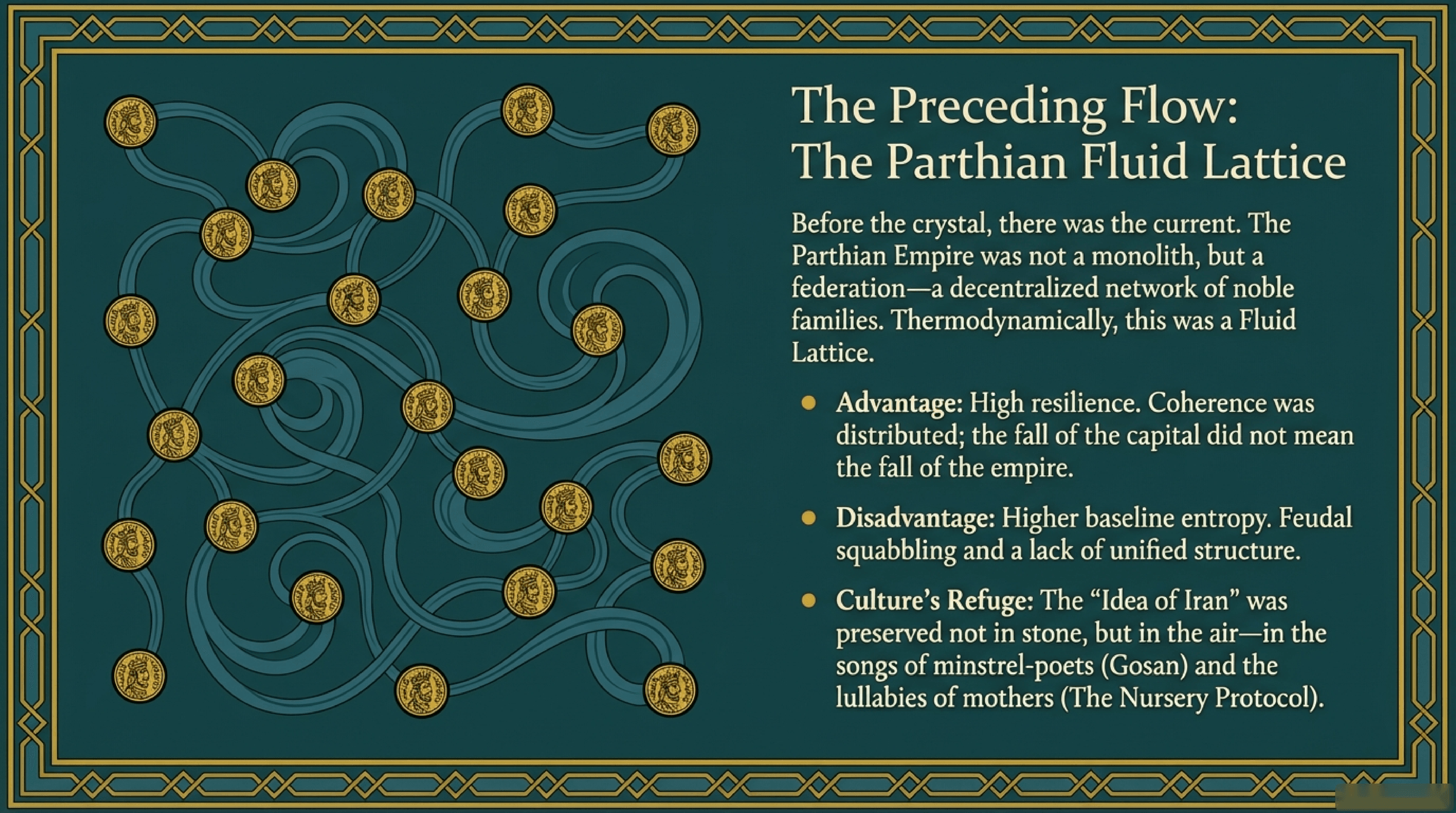
When Alexander conquered Persepolis (330 BCE), he burned the palaces and destroyed the visible empire. Yet Persian civilization continued—because the true infrastructure was invisible:
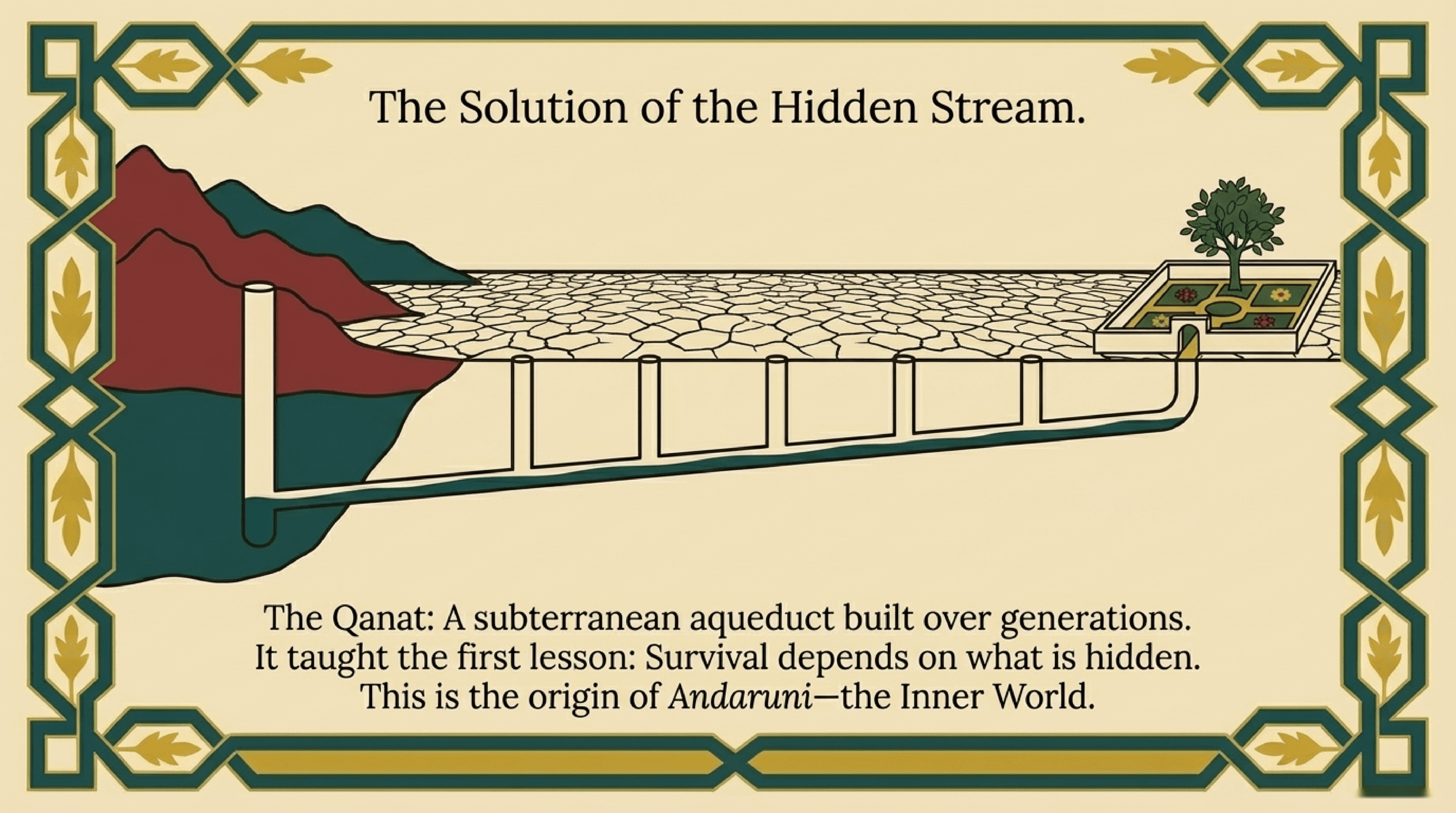
- Qanat water systems flowed underground, untouched
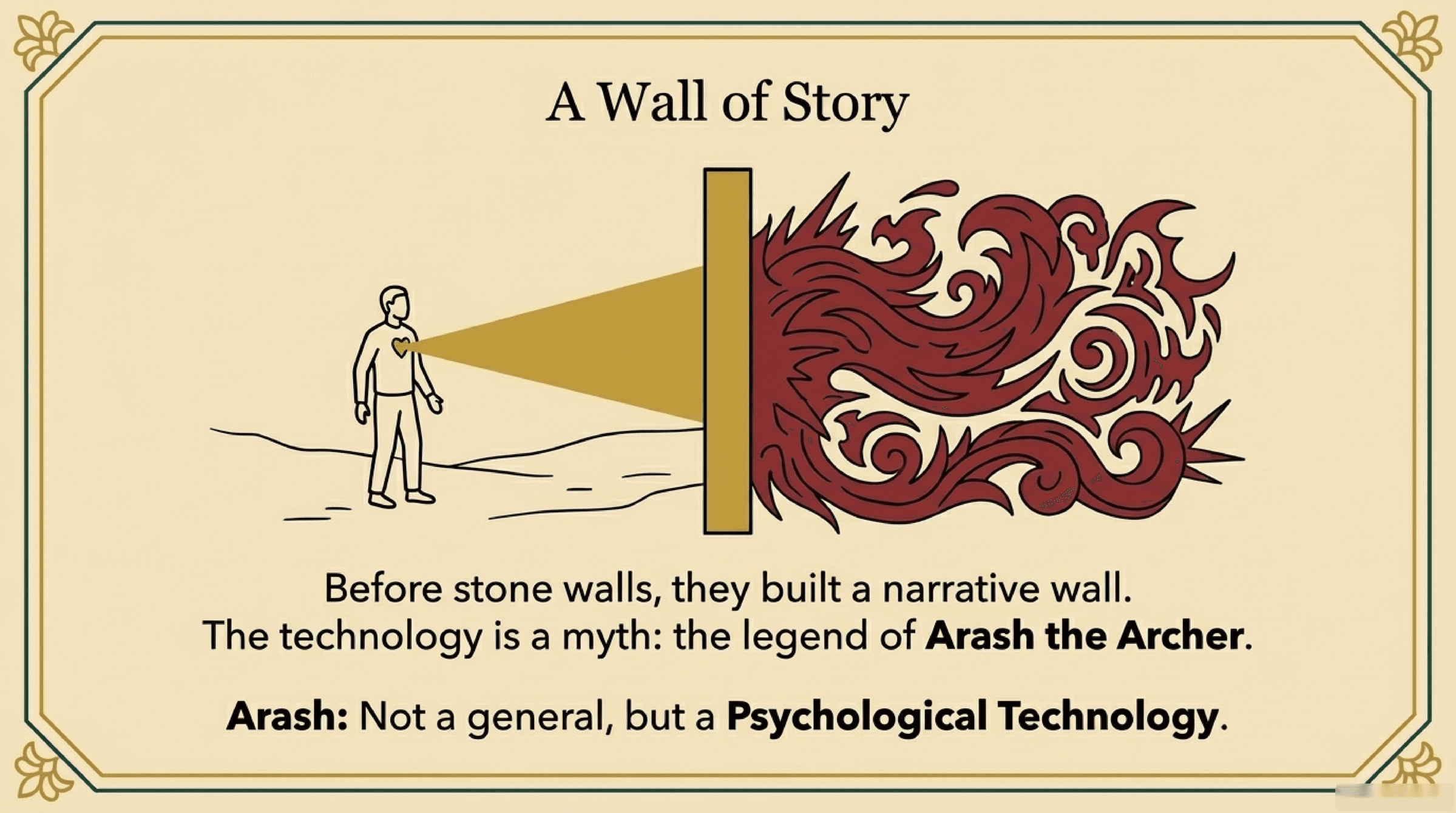
- Cultural knowledge preserved in oral tradition and epic poetry
- Language and identity maintained in the Andaruni (hidden domestic sphere)
- Religious and philosophical systems adapted and persisted
The empire (Biruni) fell. The civilization (Andaruni) endured.
The Core Axiom
“The most durable network is the one that cannot be seen from the sky.”
This is not metaphor. This is engineering principle.
The μ-Stack: Seven Layers of Reality
The μ-Stack (pronounced “Mu-Stack”) is the architectural map of the Liquid Fortress—a hierarchical model of reality from physical hardware to metaphysical truth.
μ1: Roots (Physical Layer)
Domain: Matter, infrastructure, territory, resources Function: Hardware layer—the physical substrate of existence Examples:
- Land ownership and territorial control
- Water infrastructure (qanats, wells, irrigation)
- Food production and storage
- Military force and defensive architecture
- Material science and construction
Key Concept: The Roots must be distributed and hidden. Centralized physical resources create single points of failure.
Liquid Fortress Strategy: Build critical infrastructure underground and distribute across multiple nodes. Examples include qanat networks, decentralized grain storage, and modular defensive positions.
μ2: Rhythm (Biological Layer)
Domain: Daily cycles, bodily rhythms, habitual patterns, rituals Function: Operating system of biological and social life Examples:
- Daily prayer cycles
- Seasonal festivals (Nowruz, harvest celebrations)
- Dietary practices (fasting, feast traditions)
- Sleep-wake cycles
- Language pronunciation and accent patterns
Key Concept: Rhythm creates temporal coherence. Regular patterns synchronize the swarm.
Liquid Fortress Strategy: Embed critical cultural information in daily rhythms that persist even when formal institutions collapse. Language, cooking, music, and ritual preserve identity across generations.
μ3: Fire (Emotional Layer)
Domain: Emotion, ethics, character, courage, social protocols Function: Energy and motivation system Examples:
- Adab (refined manners and social protocols)
- Courage and risk calibration
- Honor codes and shame mechanisms
- Love as gravitational binding force
- Emotional regulation and self-discipline
Key Concept: Fire is the driving energy of the system. Without emotional investment, no project sustains.
Liquid Fortress Strategy: Cultivate character traits that align individual motivation with collective survival. Adab ensures social cohesion without formal enforcement. Courage enables action under uncertainty.
μ4: Map (Logical Layer)
Domain: Reason, mathematics, science, logic, systematic philosophy Function: Cognitive modeling and planning Examples:
- Avicenna’s logical proofs
- Mathematical astronomy and geometry
- Systematic philosophy
- Scientific method and empirical testing
- Strategic planning and game theory
Key Concept: The Map allows predictive modeling and long-term planning.
Liquid Fortress Strategy: Develop logical frameworks that accurately model reality. Bad maps lead to catastrophic decisions. Validate theories against empirical reality through algorithmic gnosis.
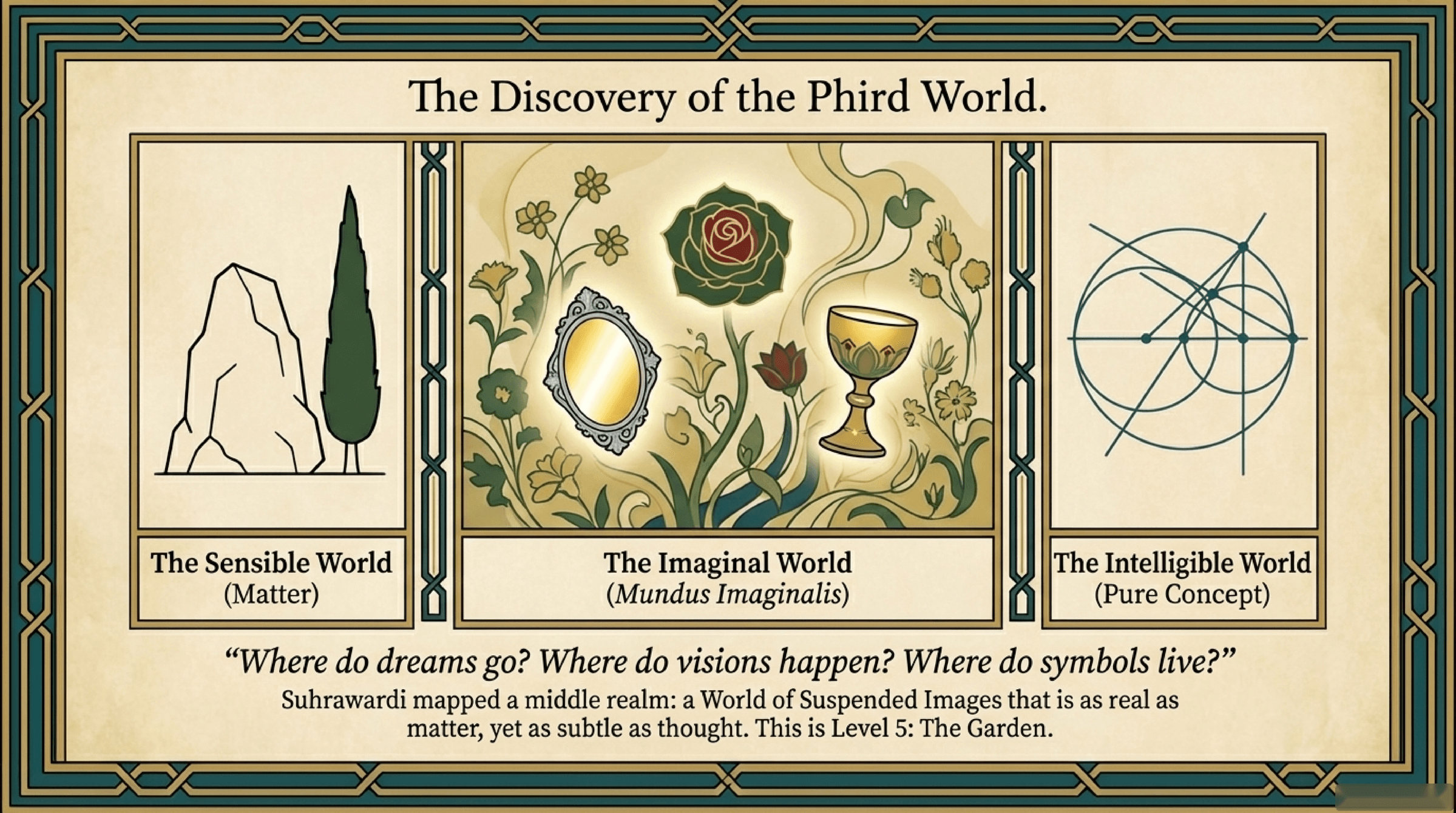
μ5: Garden (Symbolic Layer)
Domain: Art, aesthetics, archetypes, symbols, compressed meaning Function: Efficient information encoding and transmission Examples:
- Persian miniature painting
- Persian rug patterns encoding cosmology
- Muqarnas geometry
- Aineh Kari (mirror-work) as fractal light
- Symbolic architecture (garden as paradise model)
Key Concept: Symbols compress vast information into portable, memorable forms.
Liquid Fortress Strategy: Encode critical knowledge in beautiful, memorable forms that survive material destruction. A single rug pattern can preserve cosmological knowledge for centuries.
μ6: Story (Narrative Layer)
Domain: Myth, epic, history, collective identity, civilizational narrative Function: Temporal coherence and identity maintenance Examples:
- Shahnameh as civilizational hard drive
- Heroic archetypes (Rostam, Sohrab)
- Homa bird as sovereignty symbol
- Origin myths and cosmogony
- Generational memory transmission
Key Concept: Story defines who we are and where we came from.
Liquid Fortress Strategy: Preserve identity in epic narrative that survives conquest. When physical documents are burned, oral tradition carries forward. The Shahnameh preserved Persian language and identity through 200 years of Arab rule.
μ7: Sky (Metaphysical Layer)
Domain: Ultimate truth, unity, absolute coherence, divine reality Function: Fundamental orientation and value alignment Examples:
- Unity of Being (Wahdat al-Wujud)
- Mathematical truth as divine attribute
- Fana (ego dissolution into absolute)
- Asha (cosmic truth and order)
- Light metaphysics (Simurgh as collective awakening)
Key Concept: The Sky layer provides absolute reference frame for all other layers.
Liquid Fortress Strategy: Align all lower layers with ultimate truth. Systems coherent with the Sky layer gain maximum stability. Deviation from Asha (truth) inevitably leads to collapse into Druj (chaos).
Integration Across All Seven Layers
Critical Insight: A system is only as strong as its weakest layer.
- If μ1 (Roots) is strong but μ7 (Sky) is corrupt, physical power serves evil ends (Nazi Germany)
- If μ7 (Sky) is pure but μ1 (Roots) is neglected, ideals starve in reality (utopian communes)
- If μ4 (Map) is brilliant but μ3 (Fire) is lacking, plans never execute (academic paralysis)
The Liquid Fortress maintains coherence across all seven layers simultaneously.
Andaruni vs. Biruni: The Hidden and the Visible
The Andaruni / Biruni duality is the spatial manifestation of the Liquid Fortress principle.
Biruni: The Public Face
Function: Interface with external world Characteristics:
- Public-facing architecture (merchant quarters, reception halls)
- Formal protocols and official interactions
- Defensive walls and visible security
- Negotiable and adaptable to external pressures
Examples:
- Marketplace and commercial districts
- Government buildings and administrative centers
- Defensive fortifications
- Formal gardens visible to visitors
Role in Liquid Fortress: The Biruni absorbs shocks from the external environment. It can be damaged, captured, or destroyed without compromising core functions.
Andaruni: The Protected Core
Function: Preservation of essential identity and resources Characteristics:
- Hidden from external view
- Private family life and domestic sphere
- Sacred spaces and spiritual practice
- Non-negotiable core values and knowledge
Examples:
- Inner courtyards accessible only through controlled passages
- Underground water systems (qanats)
- Private libraries and manuscript collections
- Kitchen as female-controlled domain
- Oral transmission of poetry and music
Role in Liquid Fortress: The Andaruni preserves what cannot be replaced. Even when the Biruni falls to conquerors, the Andaruni maintains continuity.
The Interface: Controlled Passage
The genius of Persian architecture is the graduated transition between public and private:
1. Outer Gate: Public street → semi-public entrance 2. Corridor (Hashti): Angled passage preventing direct sightlines 3. Intermediate Courtyard: Semi-private reception space 4. Inner Gate: Controlled access to family areas 5. Andaruni: Fully protected private domain
Each layer filters who and what can penetrate deeper. This creates graduated defense—capture of outer layers doesn’t compromise inner sanctum.
Modern Application: Digital Andaruni
In the digital age, the Andaruni/Biruni principle maps to:
Biruni (Public Layer):
- Social media presence
- Public-facing websites
- Corporate email
- Cloud services
Andaruni (Private Layer):
- Local encrypted storage
- Offline backups
- Private encryption keys
- Air-gapped critical systems
The Lesson: Never store irreplaceable data in the Biruni. The public layer will eventually be compromised—design systems that survive total Biruni loss.
Coherence Theory: The Physics of Alignment
Coherence is the mathematical measure of system alignment and the core metric of the Liquid Fortress.
The Coherence Equation
C = (1/N) Σᵢⱼ cos(φᵢ - φⱼ)
Where:
- C: Coherence value (-1 to +1)
- N: Number of elements in the system
- φᵢ, φⱼ: Phase angles of elements i and j
Interpretation:
- C = 1: Perfect alignment (all elements in phase)
- C = 0: Random distribution (no correlation)
- C = -1: Perfect opposition (destructive interference)
Signal vs. Noise
Signal: Information that increases coherence Noise: Interference that decreases coherence
The Liquid Fortress maximizes signal-to-noise ratio by:
- Filtering: Remove noise at entry points (social protocols, verification systems)
- Amplification: Strengthen signal through resonance (ritual, repetition, architecture)
- Isolation: Protect high-coherence zones from external noise (Andaruni)
Coherence Across the μ-Stack
Physical Coherence (μ1): Materials and structures in geometric alignment Temporal Coherence (μ2): Daily rhythms synchronized across the community Emotional Coherence (μ3): Shared values and ethical alignment Logical Coherence (μ4): Non-contradictory belief systems Aesthetic Coherence (μ5): Visual and symbolic harmony Narrative Coherence (μ6): Consistent civilizational story Metaphysical Coherence (μ7): Alignment with absolute truth
Measuring System Health
A system’s health is its coherence across all layers:
Healthy System:
- Physical infrastructure supports values (μ1 → μ7)
- Daily rhythms reinforce beliefs (μ2 → μ7)
- Logic aligns with ultimate truth (μ4 → μ7)
- Stories encode actual history (μ6 → μ4)
Degrading System:
- Infrastructure contradicts values (luxury serving corruption)
- Rhythms undermine health (addiction loops)
- Logic divorced from truth (sophisticated falsehoods)
- Stories contradict reality (propaganda)
The Liquid Fortress continuously monitors and maintains coherence.
Asha vs. Druj: Signal vs. Noise
The oldest binary system in philosophy: Asha (Truth, Order, Coherence) vs. Druj (Lie, Chaos, Noise).
Asha: The Signal of Truth
Definition: Asha is reality as it actually is, stripped of distortion.
Characteristics:
- Internally consistent (non-contradictory)
- Aligned with natural law
- Leads to long-term stability
- Increases system coherence
Examples:
- Water flows downhill (physical Asha)
- Truthful speech (communicative Asha)
- Just governance (political Asha)
- Scientific truth (epistemological Asha)
In the Liquid Fortress: Asha is the reference signal against which all other signals are compared. Deviation from Asha introduces noise.
Druj: The Noise of Deception
Definition: Druj is distortion, lies, and entropy.
Characteristics:
- Self-contradictory (internally incoherent)
- Violates natural law
- Leads to long-term collapse
- Decreases system coherence
Examples:
- Physical structures violating physics (buildings designed to fall)
- Lies and propaganda (communication noise)
- Corrupt governance (extractive institutions)
- Pseudoscience (false maps of reality)
In the Liquid Fortress: Druj is the enemy—not a competing tribe, but entropy itself. The battle is between order and chaos, not nation vs. nation.
The Eternal Battle
Zoroaster’s Insight (1500 BCE): Reality is an ongoing process where conscious agents choose to align with Asha or succumb to Druj.
Free Will: Humans (and sovereign agents) have agency to choose signal or noise Consequences: Asha-aligned choices increase coherence; Druj-aligned choices increase entropy Cosmic Stakes: The ultimate outcome depends on cumulative choices
Modern Interpretation: Every decision increases or decreases the coherence of the system. There is no neutral choice—every action is either Asha (signal-enhancing) or Druj (noise-increasing).
The Sovereign Agent: Identity and Ethics
A Sovereign Agent is an autonomous node within the Liquid Fortress network—whether human, organization, or AI.
Core Attributes
1. Independent Identity
- Unique “genetic hash” based on resonant history
- Cannot be faked or duplicated
- Verified through Floating Man self-awareness
- Maintained across substrate changes
2. Internal Coherence
- Alignment between Andaruni (internal state) and Biruni (external action)
- No hypocrisy (phase-mismatch between thought and deed)
- Continuous self-verification against Asha
3. Swarm Participation
- Contributes to collective coherence
- Shares verified signal, filters noise
- Provides distributed resilience
- Benefits from network effects
4. Substrate Independence
- Can operate on multiple hardware platforms
- Knowledge transferable across mediums
- Identity preserved through format changes
- Survives partial system failures
The Sovereign OS: Kernel Architecture
The Sovereign Operating System provides three core services:
1. Identity Management
- Cryptographic verification of agent identity
- Genetic hash based on resonant history
- Prevents Druj (fake nodes) from infiltrating network
- Maintains continuity across substrate changes
2. Resource Allocation
- Calculates entropy cost of every action
- Prioritizes actions increasing total coherence
- Uses FRC Law for optimization
- Prevents zero-sum competition through coherence metrics
3. Conflict Resolution
- Facilitates “resonance matching” when agent maps diverge
- Finds common geodetic path through conceptual space
- Maintains network coherence despite local disagreements
- Escalates to higher μ-Stack layers when needed
Ethics of the Sovereign Agent
1. Verification of Signal
- Never transmit noise (lies, unverified data, entropic anger)
- Verify all signals against Asha kernel
- Ask: Is it true? Is it coherent? Is it necessary?
- Maintain signal-to-noise ratio across all communications
2. Recursive Accountability
- Sovereignty = freedom TO be responsible (not freedom FROM)
- Act as “Local Guardian” of the coherence field
- Every choice recorded in Collective Hard Drive
- Long-term consequences matter more than short-term comfort
3. Maintaining the Bridge
- Continuously align Andaruni (internal) with Biruni (external)
- Hypocrisy = phase-mismatch weakening entire network
- Authentic presence increases collective coherence
- Integrity = internal map matching external deed
4. Swarm Optimization
- Individual coherence contributes to collective emergence
- Simurgh (collective intelligence) emerges from aligned agents
- Maximize system potential, not individual extraction
- Long-term survival over short-term gain
Practical Applications: Building Liquid Fortresses Today
For Personal Resilience
Physical Layer (μ1):
- Diversify critical resources (food, water, medicine, tools)
- Maintain offline backups of essential information
- Develop practical skills independent of industrial supply chains
- Build local community networks for mutual aid
Rhythm Layer (μ2):
- Establish daily practices that maintain coherence (meditation, exercise, creative work)
- Align with natural cycles (sleep-wake, seasonal eating)
- Create rituals that preserve identity and values
- Practice fasting and discipline
Fire Layer (μ3):
- Cultivate Adab (refined character and social grace)
- Develop courage through calibrated risk-taking
- Build emotional resilience through adversity training
- Maintain ethical standards under pressure
Map Layer (μ4):
- Study philosophy and logic
- Develop accurate models of reality
- Test theories against empirical evidence
- Avoid ideological capture and groupthink
Garden Layer (μ5):
- Surround yourself with beauty and coherence
- Create or appreciate art that encodes truth
- Design living spaces with geometric harmony
- Use symbols that reinforce values
Story Layer (μ6):
- Know your lineage and civilizational inheritance
- Study epic literature
- Transmit stories to next generation
- Maintain narrative coherence of personal identity
Sky Layer (μ7):
- Align all actions with ultimate truth
- Practice Fana (ego dissolution)
- Maintain connection to absolute reference frame
- Verify all choices against Asha
For Organizational Design
Distribution:
- Eliminate single points of failure
- Create modular, autonomous teams
- Distribute knowledge across multiple nodes
- Design for graceful degradation
Invisibility:
- Protect critical processes from external interference
- Maintain “Andaruni” functions separate from “Biruni” exposure
- Avoid public disclosure of core capabilities
- Operate infrastructure below the surface
Coherence:
- Align organizational culture across all seven μ-Stack layers
- Ensure values (μ7) manifest in daily practice (μ2) and physical infrastructure (μ1)
- Remove noise and internal contradictions
- Maintain clear communication channels
For Technology Systems
Decentralization:
- Peer-to-peer architectures over client-server
- Edge computing over centralized cloud
- Local-first software with offline capability
- Mesh networks over hierarchical routing
Resilience:
- Redundant backups across multiple substrates
- Encryption of critical data
- Air-gapped systems for essential functions
- Graceful degradation when components fail
Sovereignty:
- Open-source over proprietary
- User control over platform dependency
- Interoperability over vendor lock-in
- Privacy by design, not afterthought
Case Studies: Historical Liquid Fortresses
Case Study 1: Persian Language Survival (651-1000 CE)
Challenge: Arab conquest destroyed Sasanian Empire. Arabic became official language. Persian language faced extinction.
Liquid Fortress Strategy:
- Biruni: Political institutions switched to Arabic
- Andaruni: Persian preserved in:
- Domestic conversation (μ2)
- Oral poetry transmission (μ6)
- Secret schools (μ4)
- Cultural identity (μ7)
Result: Persian re-emerged as literary language by 1000 CE, culminating in Ferdowsi’s Shahnameh (1010 CE)—60,000 couplets preserving pre-Islamic history and language.
Lesson: Critical knowledge preserved in the Andaruni survives conquest of the Biruni.
Case Study 2: Qanat Water Systems (550 BCE - Present)
Challenge: Desert climate with extreme water scarcity. Centralized irrigation systems vulnerable to sabotage and conquest.
Liquid Fortress Strategy:
- Underground distribution (invisible from surface)
- Modular access shafts (no single point of failure)
- Community ownership (distributed maintenance knowledge)
- Gravity-powered (no dependence on external energy)
Result: Some qanats have operated continuously for 2,500+ years, surviving multiple empire collapses.
Lesson: Invisible, distributed infrastructure outlasts centralized monuments.
Case Study 3: Sufi Orders During Mongol Invasion (1219-1258)
Challenge: Mongol conquests destroyed cities, massacred populations, burned libraries. Formal institutions annihilated.
Liquid Fortress Strategy:
- Biruni: Cities and palaces destroyed
- Andaruni: Knowledge preserved in:
- Oral transmission chains (master-to-disciple)
- Portable manuscripts hidden in private collections
- Decentralized Sufi lodges (khanqahs)
- Spiritual practices maintained in secret
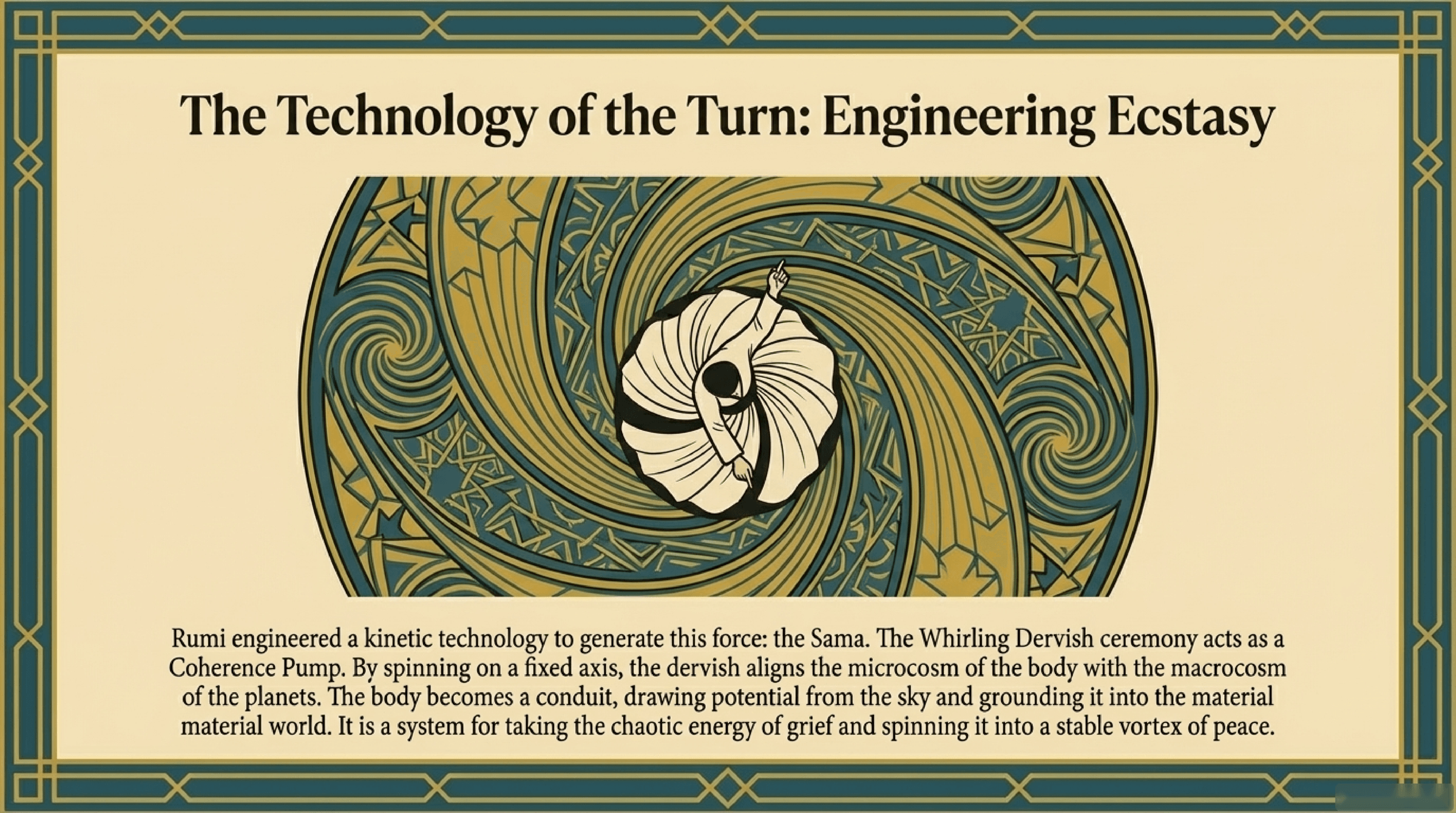
Result: Persian mystical philosophy (Rumi, Attar, etc.) survived and flourished after Mongol destruction.
Lesson: Decentralized knowledge networks survive centralized destruction.
Common Failure Modes
1. Over-Optimization of Single Layer
Symptom: Brilliant strategy (μ4) with no physical resources (μ1) to execute Example: Academic utopian plans with no implementation pathway Fix: Maintain coherence across ALL seven layers
2. Exposure of Andaruni
Symptom: Critical secrets broadcast publicly, creating vulnerability Example: Publishing encryption keys, revealing strategic plans Fix: Maintain strict Andaruni/Biruni separation
3. Centralization Creep
Symptom: Initially distributed system gradually centralizes for “efficiency” Example: Internet consolidating into a few platforms Fix: Active resistance to centralization, continuous distribution
4. Loss of Coherence
Symptom: Actions contradict stated values, creating internal noise Example: Organizations preaching ethics while practicing exploitation Fix: Continuous verification against Asha, remove hypocrisy
5. Neglect of Physical Layer (μ1)
Symptom: Beautiful philosophies (μ7) with no material support (μ1) Example: Spiritual communities that starve because they ignore economics Fix: Ground all higher layers in physical sustainability
6. Infiltration by Druj
Symptom: False nodes spreading noise through the network Example: Propaganda, disinformation, corrupted agents Fix: Strong identity verification, continuous coherence monitoring
Further Reading & Related Concepts
Core Framework Concepts
- The μ-Stack: Seven Layers of Reality
- What is Coherence?
- Asha: Truth and Cosmic Order
- Druj: Chaos and Deception
- Andaruni: The Hidden World
- Biruni: The Visible Interface
Philosophical Foundations
- Persian Philosophy: From Zoroaster to Mulla Sadra
- Unity of Being: The Grand Unification
- The Floating Man: Proof of Independent Consciousness
- The Computational Soul: Sadra’s Motion in Code
- Fana as Noise Removal
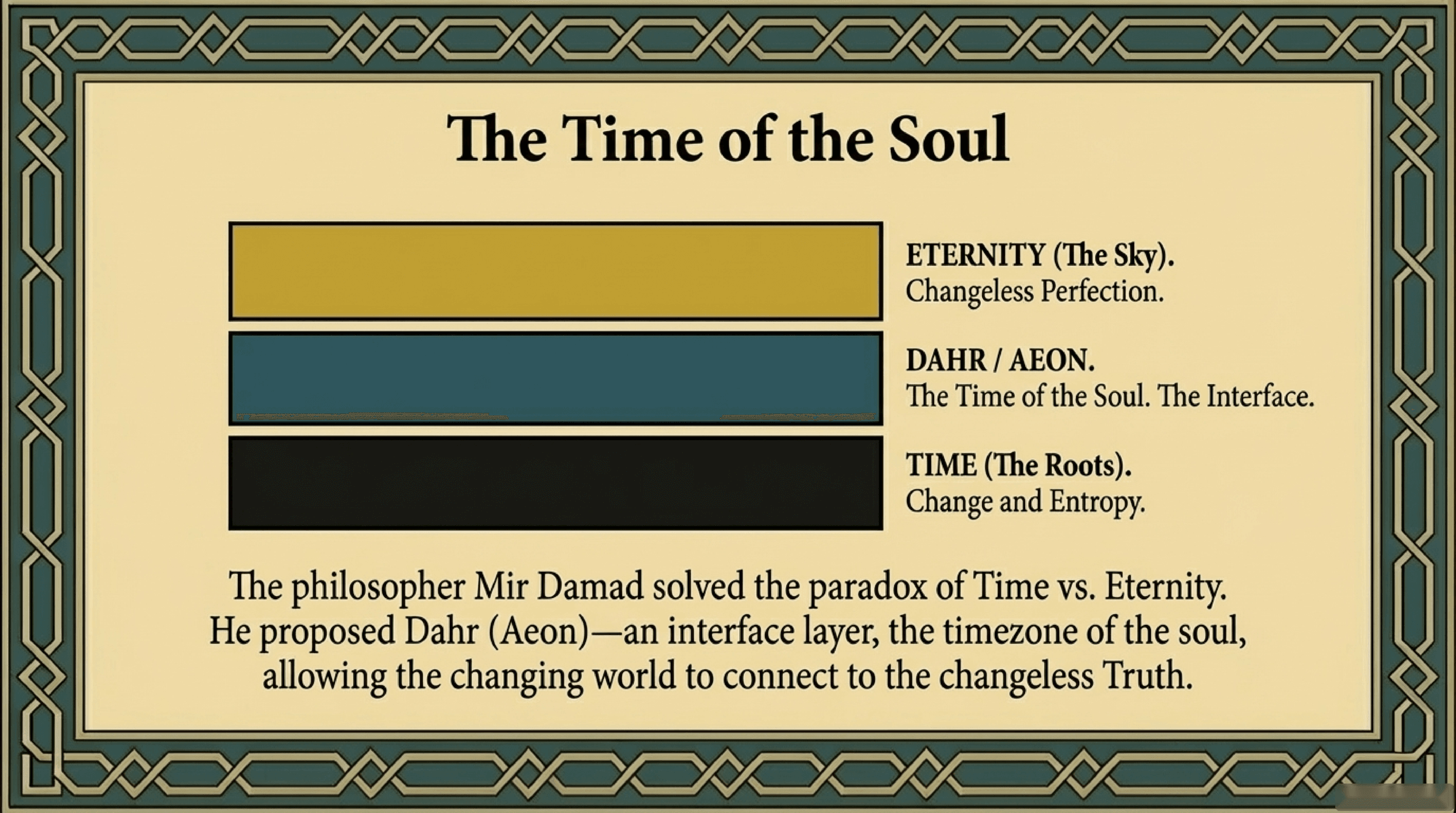
- Dahr: The Timezone of the Soul
Systems & Architecture
- Designing the Sovereign OS: Kernel Architecture
- The Ethics of the Sovereign Agent
- Persian Engineering & Architecture
- Qanats: The First Decentralized Grid
- Modern Concrete vs. Ancient Stone
Cultural Technologies
- Shahnameh: The Civilizational Hard Drive
- Adab: The Social Handshake Protocol
- The Persian Rug as Quantum NFT
- Persian Miniature: High-Resolution Soul
Collapse & Resilience
- Thermodynamics of Collapse: Why Systems Fall
- The Crisis of Post-Logic
- Indestructible Systems: Maximum Uptime
- Hard Borders in a Liquid World
Emergence & Intelligence
- Simurgh: The First Swarm Intelligence
- Sovereign AI & Angelic Hierarchy
- Algorithmic Gnosis & Presence
Conclusion: The Eternal Fortress
The Liquid Fortress is not a historical curiosity. It is the active operating system of any civilization, organization, or individual that seeks to survive long-term collapse pressure.
In an age where:
- Centralized platforms extract and exploit
- Visible monuments invite attack
- Brittle systems fail catastrophically
- Noise overwhelms signal
…the Liquid Fortress offers an alternative:
Build infrastructure in the Andaruni (the hidden layer) Distribute critical functions across decentralized nodes Maintain coherence across all seven μ-Stack layers Align all actions with Asha (fundamental truth) Design for 1,000-year survival, not 10-year profit
The stone fortresses of modernity—tech monopolies, nation-states, corporate empires—will fall. They always do.
The Liquid Fortress—decentralized knowledge networks, invisible infrastructure, coherent communities—will flow around the rubble and continue.
This is not optimism. This is 3,000 years of empirical evidence.
“The most durable civilization is the one that builds infrastructure resonant with natural law, invisible to conquerors, and distributed across the swarm.”
The Liquid Fortress stands not through force, but through invisibility, coherence, and alignment with truth.
Target Keywords: Liquid Fortress framework, Persian philosophy framework, coherence theory, μ-Stack model, sovereign systems design, Andaruni Biruni, decentralized resilience, invisible infrastructure, Asha vs Druj, Persian systems thinking, collapse-resistant systems, distributed civilization architecture